
Framework coverage
The edition comparison lists Pytest, Python UnitTest, Robot Framework, Postman, Maven, Gradle, JMeter, and JUnit. Confirm how your current assets map to those supported frameworks.
Build reusable automated coverage across recorded user flows, backend services, and multi-step business journeys. Keep the testing logic visible, move repeatable checks earlier, and choose the edition that matches your runtime and collaboration needs.

For QA and quality engineering teams
Testany combines recorded front-end and end-to-end flows with multi-framework test assets and pipeline orchestration. QA teams can model a business journey, reuse cases and data across regression plans, and run the same repeatable checks from development through release without rebuilding every plan by hand.
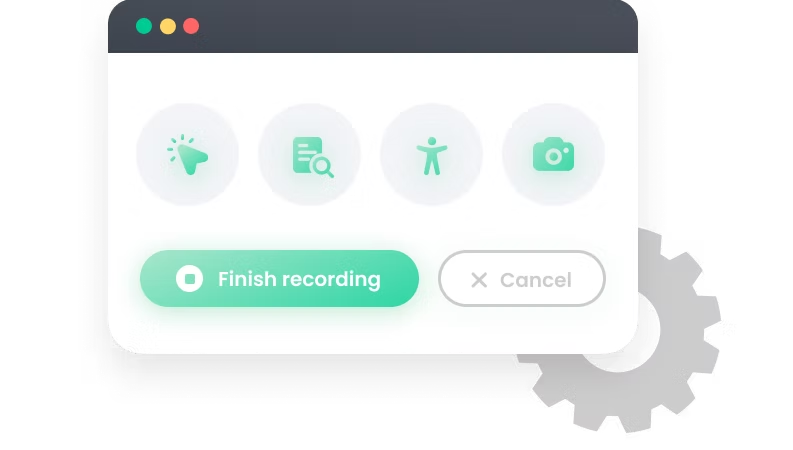
Use recorded front-end and end-to-end flows to accelerate the creation of repeatable automated checks. Keep each flow tied to a business journey, then review and maintain it as the interface and expected behavior change.
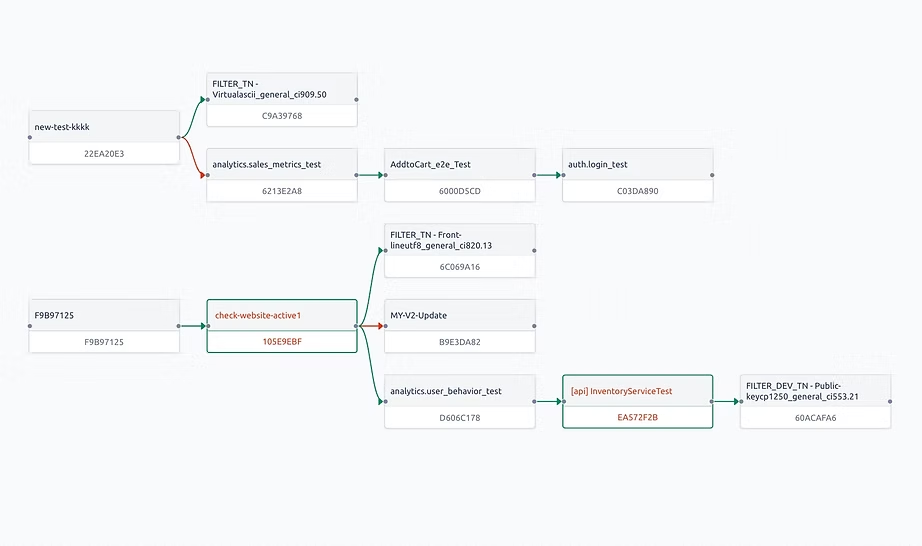
Compose test cases into a pipeline that represents business logic across multiple backend services. Reuse cases in different plans, and relay output data between cases when a later step depends on an earlier response.
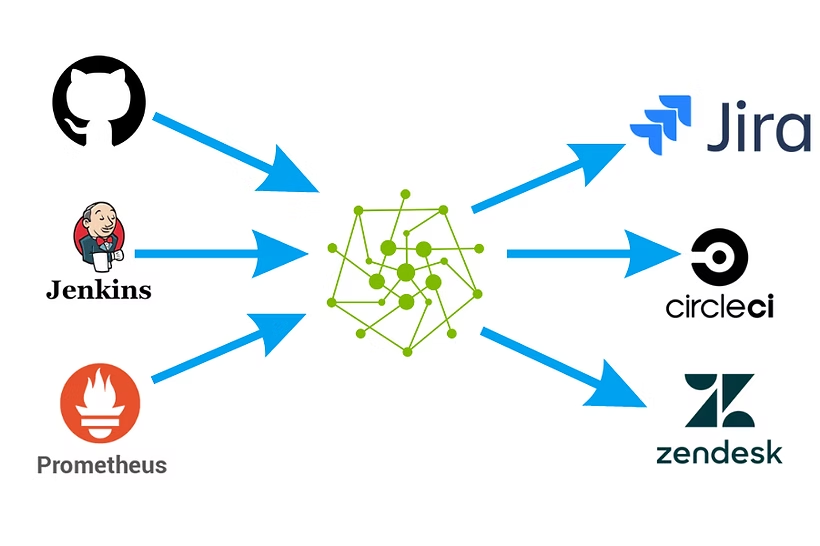
Bring supported frameworks and script sources into one execution flow. Manual, scheduled, and event-driven triggers plus supported notification channels help teams connect results to the process they already operate; confirm channel availability for the selected edition.
A practical workflow
Start with the risk and expected behavior, then use Testany to organize reusable test assets rather than treating automation volume as the goal.
Identify the user or service path, its important branches, required environments, and the result that should stop a release.
Combine recorded flows and supported test frameworks, then separate reusable cases from data that changes by environment.
Map the business order in a pipeline, relay data across dependent cases, and choose manual, scheduled, or event-driven execution.
Use each run to inspect failures, update the affected case or data, and keep the regression plan aligned with the release risk.
Case-study evidence
The published case describes a 13-person QA team in three locations using Gatekeeper, Output Relay, and Testany Secrets Service to automate integration and regression testing for a complex IoT platform.
These figures are reported by one anonymized case study. They describe that team and environment; they are not a guarantee of results for every deployment.
Read the IoT platform case studyPlan the rollout
Test design still belongs to the QA team. Testany provides generation, orchestration, execution, data relay, and integrations within the limits published for each edition.
The edition comparison lists Pytest, Python UnitTest, Robot Framework, Postman, Maven, Gradle, JMeter, and JUnit. Confirm how your current assets map to those supported frameworks.
A pipeline can contain up to 64 test cases. Pipeline and in-pipeline test-case concurrency differ by edition, so size regression plans around the published limits.
Community and Commercial use shared deployment; Enterprise adds dedicated deployment and local self-managed runtime. One credit represents one test pipeline execution.
QA team FAQ
The current comparison lists Pytest, Python UnitTest, Robot Framework, Postman, Maven, Gradle, JMeter, and JUnit. Check your framework, version, dependencies, and script source against the product documentation before migration.
Relay Cases are listed as a platform capability for passing data across cases. Use them when one step produces a value required by a later step, while keeping environment-specific data and credentials under the appropriate controls.
This solution covers repeatable automated flows and makes no claim to replace exploratory testing. Keep human investigation for new, ambiguous, or experience-focused risk while automating stable checks that benefit from repeated execution.
One credit equals one test pipeline execution. Community starts with 500 free credits and Commercial with 2,000; unit prices, concurrency, deployment, and support differ by edition on the pricing page.
Continue evaluating
Review the QA team profile, its shift-left workflow, and the reported coverage and regression-cycle results.
Compare credits, concurrency, supported frameworks, deployment models, notification channels, and support.
Use the product documentation to validate framework, pipeline, data relay, and environment configuration details.